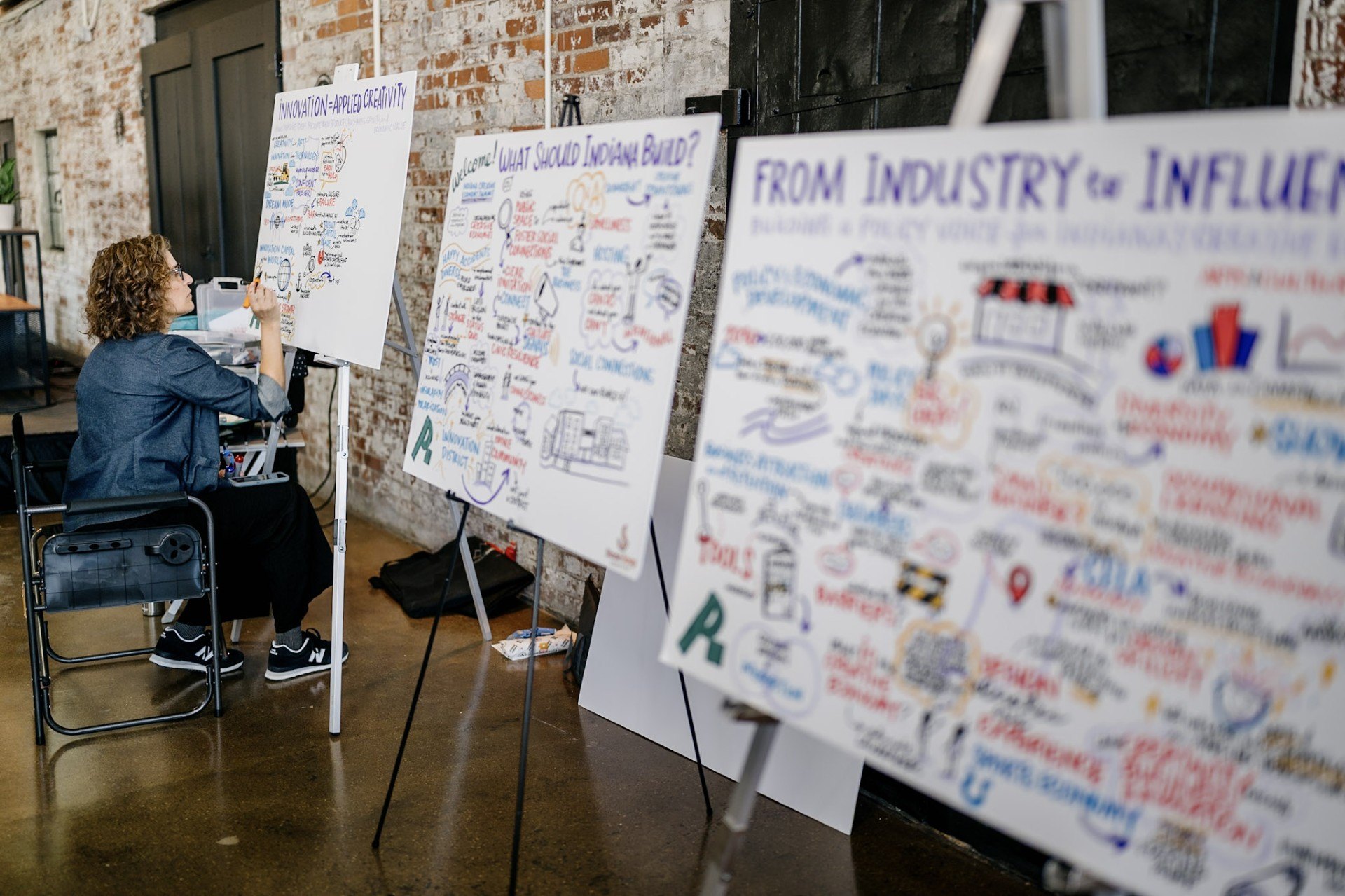
Ideas take visual form as Julia Reich of Stone Soup Creative captures conversations from Indiana’s Creative Economy Summit. Photo courtesy of PATTERN.
Some places just make it easy to stay awhile. You stop to wait for someone and end up people-watching. You hear something happening around the corner and wander over. You run into someone you know, start talking, and suddenly you’re twenty minutes late to wherever you were headed in the first place. Other places can be full of people and somehow still feel like somewhere you’re supposed to pass through. What makes the difference?
It’s a question we came home with after two days at Indiana’s Creative Economy Summit. Amid conversations about entrepreneurship, economic development, culture and community, we kept circling back to something surprisingly simple: creativity rarely happens in isolation. Ideas grow through exchange, exposure to different perspectives and the kinds of conversations that send our thinking somewhere new.
For us, that opened up a design question. We spend a lot of time thinking about the places where people live, work, learn, gather and play. If connection is part of what makes creativity possible, what can the places we design do to make more of it possible?
Being together isn’t the same as connecting
We talk often about designing spaces for connection. Gathering spaces, collaboration spaces, community spaces, public spaces – they’re part of nearly every project conversation in one form or another. Of course, putting people in the same place doesn’t mean they’ll interact.
We’ve all walked through a beautiful plaza that nobody seems to use, or sat in a lobby where lingering somehow feels awkward. We’ve experienced the opposite, too – an unassuming courtyard where everyone seems to hang around. A set of steps that becomes an impromptu meeting place, a café edge where a quick stop turns into an hour.
The difference isn’t always a grand design gesture. Perhaps it’s something as simple as permission – to stop, to watch, to sit without a particular reason, or to participate halfway before deciding whether you want to join. At the Summit, one phrase captured that idea particularly well – the place before the place.
The place before the place
Think about any destination people gather around – a restaurant, concert, community event or cultural venue. There’s the place itself, and then there’s everything around it: the sidewalk, plaza, front steps, or bench under a tree. The patch of public space where you can linger for a few minutes without feeling like you need a reason to be there. These spaces can seem secondary to the destination. Yet they’re often where some of the most human moments happen. You run into someone you know. You hear music coming from around the corner. Someone asks what’s happening inside. You stay a little longer than you planned – you tiptoe in.
For communities thinking about creativity, culture and economic vitality, these moments matter. Participation doesn’t always begin with someone walking confidently through the front door. Sometimes it starts on the periphery. And that edge can be designed.
Designing the invitation
A welcoming space is a good start. But an invitation asks a little more of us as designers. It asks us to think about the experience of the person who isn’t quite sure whether they belong there yet. Can someone comfortably observe before participating? Can they linger without buying something or committing to an activity? Can they see what other people are doing? Are there natural opportunities for paths to cross? Does the transition between inside and outside encourage curiosity? Is there enough activity to create energy and enough breathing room to simply be?
That might mean giving people a comfortable edge to occupy – a seat along a walkway, a low wall, a shaded corner or a generous threshold between indoors and out. Making activity visible matters, too. A glimpse through a window, an open door or a program spilling into the public realm can turn something happening “over there” into something that feels available to join. Bringing different uses together can create overlap between people who arrived for entirely different reasons. And there’s value in leaving a little room for the unexpected.
The best social spaces don’t dictate exactly how people should use them. They offer choices. Sit here, walk through, stay awhile, watch from over there, join when you’re ready. Those small choices can soften the edges of a place and make participation feel less like an all-or-nothing proposition.
And in the context of a creative economy, that matters. Ideas move between people. Businesses grow through relationships. Innovation happens when different perspectives collide. Communities develop identities through the things people make, share and experience together.
Through that lens, social connection is more than a pleasant side effect of a thriving place. It’s part of the infrastructure that allows one to exist.
We readily understand the role of roads, utilities, housing and digital connectivity in supporting economic activity. The physical places that help people build relationships, exchange ideas and encounter perspectives beyond their own are part of the equation, too.
For designers, that creates an opportunity. We can’t manufacture a meaningful interaction. We can’t predict who will meet whom, what they’ll talk about or whether an unexpected conversation will become the beginning of an idea, a friendship, a business or nothing at all. But we can create more openings for those moments to happen by paying attention to the edges, making room to linger and creating places that feel approachable while leaving a little space for the unexpected.
That’s the invitation we can design. Creativity can begin long before the blank page, sketch or the big idea. Sometimes it begins when someone arrives a few minutes early, finds a comfortable place to stay, and starts talking to the person next to them.